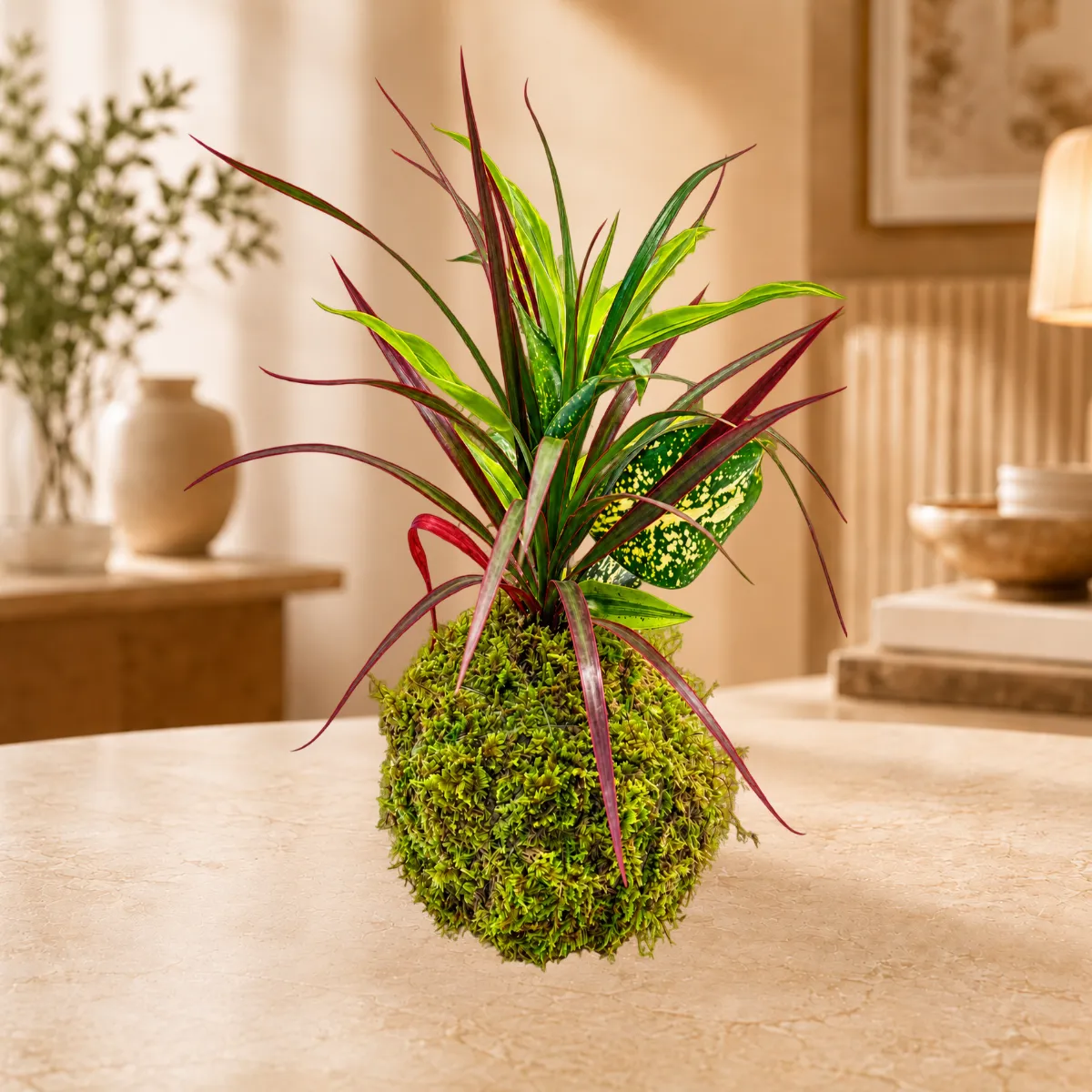
Three Plant Kokedama
Dracaena marginata brings the lines, thin leaves edged in deep red that spray outward and arch down past the moss. Dracaena fragrans fills the center in lime and chartreuse, broader and softer, holding the middle together. Gold dust croton sits low behind them, dark green speckled with yellow, giving the whole thing a floor.
They work together because they want the same things. All three are tropical, all three take bright indirect light, and all three drink on roughly the same schedule, which is what makes a combined planting possible at all. The reds, limes, and golds were picked to sit in the same range without flattening into one color.
Three plants on one ball also means three growth habits going in different directions, so this one changes shape more than our single plantings do. It will not look the same in six months, and that is the point of it.
Details
- Dracaena marginata, Dracaena fragrans, and gold dust croton (Codiaeum variegatum ‘Gold Dust’)
- Category: Tropical
- Live moss ball, hand formed
- Display dishes sold separately
- Toxic to cats and dogs if chewed
- Handmade individually, so moss coverage, ball shape, and plant size vary from the photo.
- Approximate Size: 5″ X 12″
Care
- Light: bright indirect light. The croton needs it most, and the colors on all three fade without enough. Keep it out of direct sun.
- Water: soak 2 to 3 minutes, drain fully, then let the ball dry down noticeably before the next soak. Roughly every 7 days indoors. Check by weight. Heavy means wait, light means water.
- Water quality matters here. Both dracaenas are sensitive to fluoride and chlorine, and tap water is the usual cause of brown leaf tips. Use filtered or distilled water, or leave tap water out overnight before soaking.
- Temperature: normal indoor range, above 60F / 15C. Keep it away from cold drafts and heating vents.
- Humidity helps, especially for the croton. Dry winter air is what makes it drop leaves.
- Rotate it every few weeks. Three plants reaching for the same window will go lopsided fast.
- Croton leaf drop after it arrives is normal. It reacts to any change in light and recovers once it settles.
Every ball is formed and wrapped by hand, so the jute pattern and the shape of the sphere are unique to your piece. The plant varies too, in size, form, and color. Yours will not look exactly like the photo, and we think that is the best part.