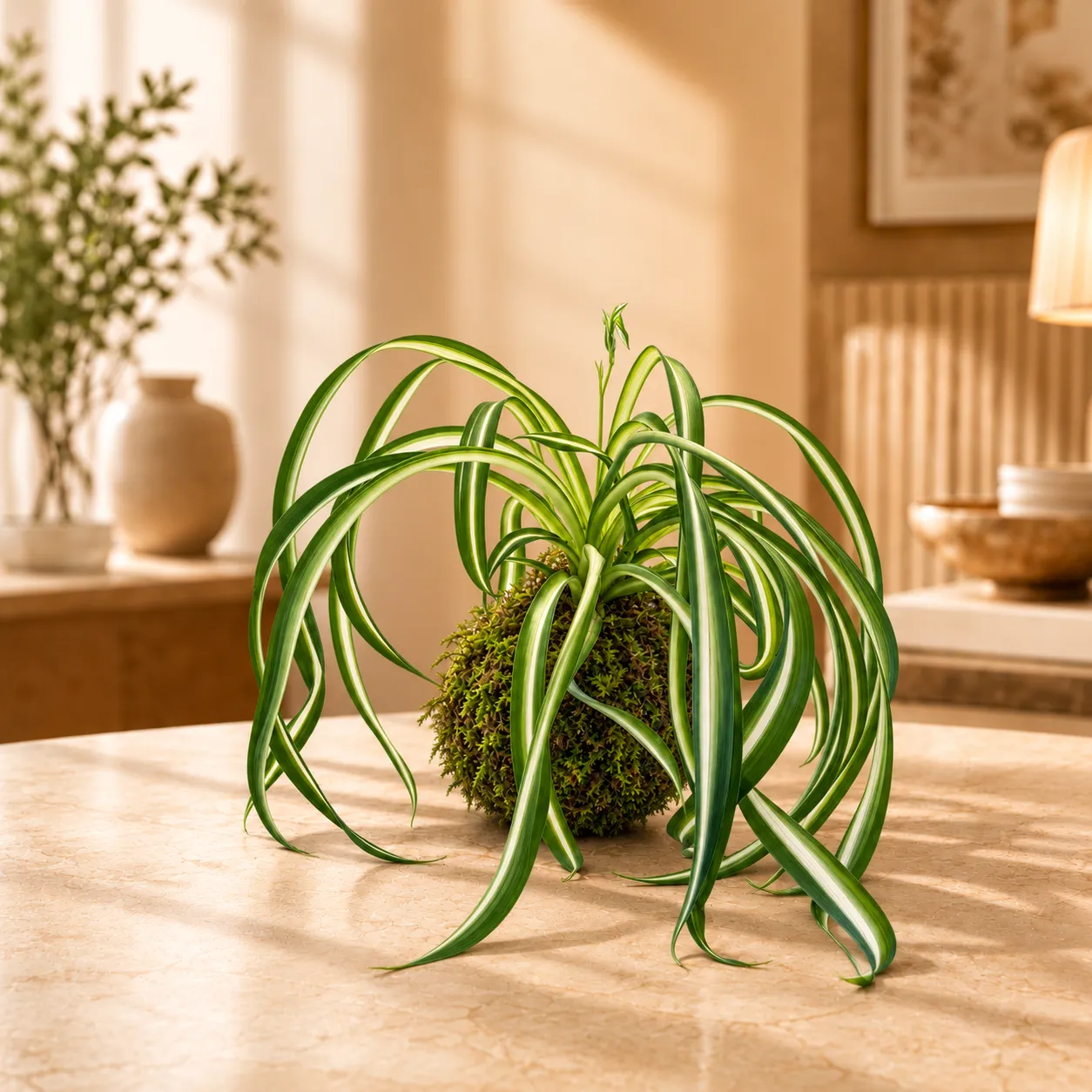
The spider plant is one of those houseplants that has been in circulation so long it feels like it has always been here. Hanging in kitchens, perched on filing cabinets, passed between neighbors as a cutting. It survives almost anything and it multiplies, which is how it got everywhere.
Narrow leaves striped in cream and green arch up out of a tight crown and then fall, curving well past the base of the plant. On a moss ball that habit finally makes sense. The leaves cascade around the sphere instead of piling against the rim of a pot, and the ball sits inside the spray rather than under it.
Give it enough light and it will send out runners, thin stems with small plantlets on the ends. Those can be cut and rooted, which is how most spider plants in the world got where they are.
Details
- Spider plant (Chlorophytum comosum)
- Category: Tropical
- Live moss ball, hand formed
- Display dishes sold separately
- Non toxic to cats and dogs
- Handmade individually, so moss coverage, ball shape, and variegation vary from the photo.
- Approximate size: 10″ X 10″
Care
- Light: bright indirect light. It tolerates medium light, but the stripes stay sharper and the runners come more freely in a bright spot. Direct sun scorches the leaves.
- Water: soak 2 to 3 minutes, drain fully, then let the ball dry down partway before the next soak. Roughly every 7 days indoors. Check by weight. Heavy means wait, light means water.
- Water quality matters with this one. Spider plants are sensitive to fluoride and chlorine, and tap water is the usual cause of brown leaf tips. Use filtered or distilled water, or leave tap water out overnight before soaking.
- Temperature: normal indoor range, above 60F / 15C. Keep it away from cold drafts and heating vents.
- Brown tips can be trimmed at an angle with clean scissors. Trim just inside the brown and leave a thin edge, it looks more natural than cutting straight across.
- Runners and plantlets are a sign the plant is happy. Leave them for the look, or cut one off and root it in water to start another.
Every ball is formed and wrapped by hand, so the jute pattern and the shape of the sphere are unique to your piece. The plant varies too, in size, form, and color. Yours will not look exactly like the photo, and we think that is the best part.