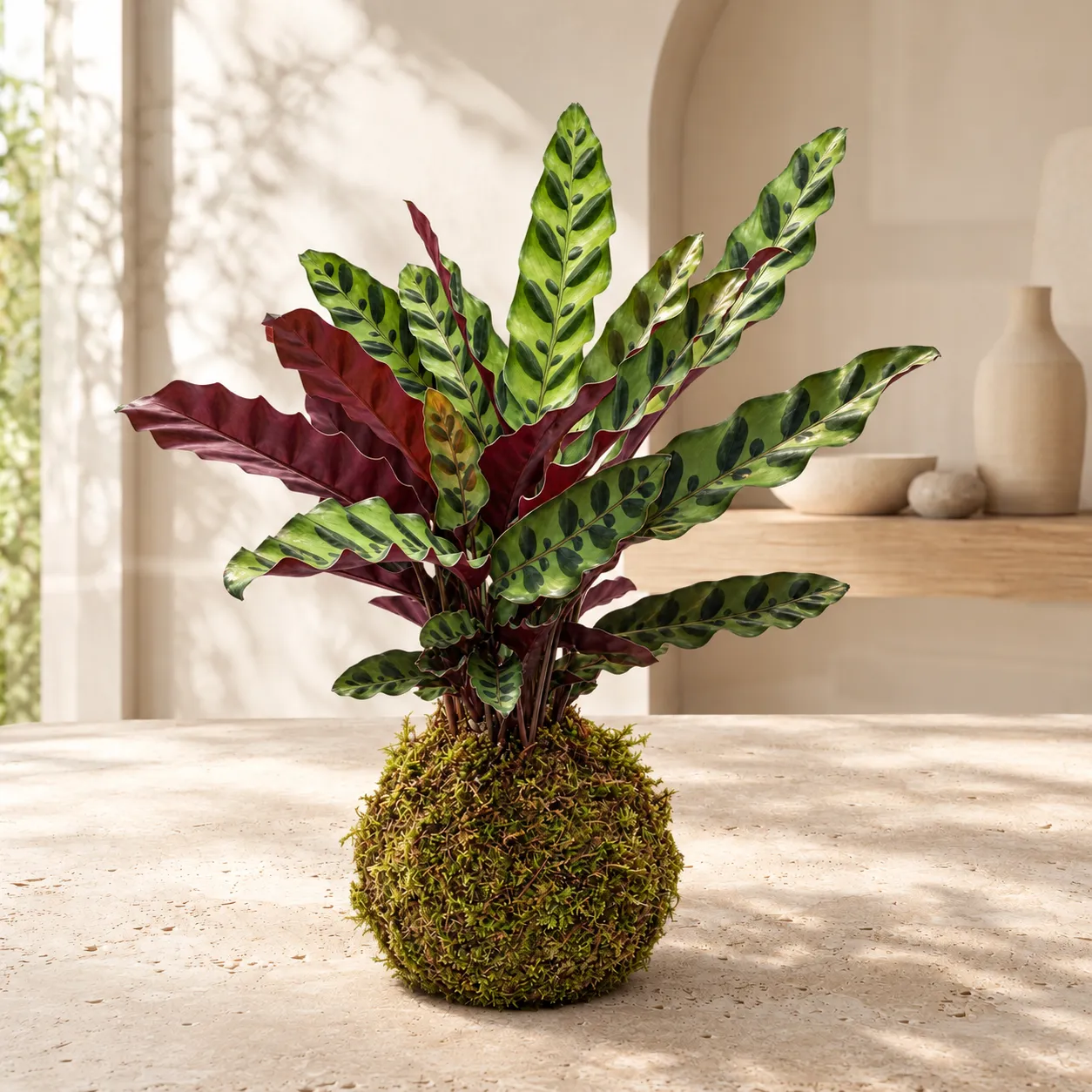
The pattern is the point. Long wavy leaves marked with alternating dark green brushstrokes down either side of the midrib, which is where the name comes from. Turn one over and the whole underside is deep burgundy purple. Few houseplants give you two colors on one leaf.
It also moves. Calatheas fold their leaves upward at night and open them again in the morning, slowly enough that you notice it only by comparing one glance to another. The plant looks different in the evening than it did at noon.
On a moss ball this works better than it does in a pot. Calatheas want even moisture without standing water, and soaking the ball delivers exactly that. The leaves fan out above and the moss sits below, dark green and purple against living green.
This is the most demanding plant we make. It is worth saying plainly: it wants humidity, warmth, and clean water, and it will tell you immediately when it is not getting them. If you want a plant that forgives neglect, we make several. This is not one of them. What it offers instead is foliage nothing else in the catalog comes close to.
Details
- Rattlesnake plant (Goeppertia insignis, formerly Calathea lancifolia)
- Category: Tropical
- Live moss ball, hand formed
- Display dishes sold separately
- Non toxic to cats and dogs
- Handmade individually, so moss coverage, ball shape, and leaf pattern vary from the photo.
Care
- Light: indirect light only. This one grows under a canopy in the wild and direct sun will bleach the pattern and scorch the edges. A bright room with no sun hitting the leaves is ideal.
- Water: soak 2 to 3 minutes, drain fully. Keep the ball damp at all times, roughly every 4 to 5 days indoors. Check by weight. Light means water now.
- Water quality matters more here than on anything else we make. Calatheas are sensitive to fluoride, chlorine, and salts, and tap water is the usual cause of brown crispy edges. Use filtered or distilled water, or leave tap water out overnight before soaking.
- Humidity is not optional. Average indoor air is too dry, and the edges will brown. A bathroom, a kitchen, a pebble tray, or a small humidifier nearby all work.
- Temperature: above 65F / 18C. Keep it well away from cold drafts, heating vents, and exterior doors.
- Leaves folding up at night is normal and healthy. Leaves curling inward during the day means it is thirsty or the air is too dry.
- Browning edges are the first complaint. They are almost always water quality or humidity, not underwatering.
Every ball is formed and wrapped by hand, so the jute pattern and the shape of the sphere are unique to your piece. The plant varies too, in size, form, and color. Yours will not look exactly like the photo, and we think that is the best part.